Start with the foam difference
Saucony’s Guide 18 uses PWRRUN cushioning, while Hurricane 25 places PWRRUN PB within a supportive PWRRUN construction. This is a real difference beneath the foot, not simply two levels on a support scale. It makes the Hurricane worth comparing when cushioning feel is the main reason for shopping.
Do not assume that a more elaborate foam package will automatically make your running easier. The benefit must show up in your own experience. A straightforward cushioning setup that feels predictable may be preferable to another shoe whose softness or transition distracts you.
Their guidance has a shared foundation
Both versions use Saucony’s CenterPath approach, which emphasizes the overall platform and sidewall geometry. Buying the Hurricane is therefore not simply buying guidance that is absent from the Guide. You are comparing two implementations with different cushioning packages.
The Guide’s role is an everyday cushioned trainer, and Saucony positions Hurricane 25 around maximum cushioning. Those descriptions help explain the intended emphasis, but they do not measure how much correction your foot receives. Neither model name establishes a diagnosis or a required support level.
Check the exact version and the actual fit
This comparison covers Guide 18 and Hurricane 25, not every version that has carried either name. In particular, Saucony lists Hurricane 25 at six millimeters of drop. A listing that calls this specific model eight millimeters deserves checking against the manufacturer before purchase.
Fit the two pairs independently. Look for enough space through the forefoot and secure hold around the heel. If you use an insert, compare both with that same setup. Cushioning that feels excellent in the shop can lose its appeal if the upper squeezes your instep during longer outings.
Use your weekly runs to choose
For mostly ordinary easy runs, start with whichever pair feels comfortable and offers better value in your size. If you specifically want a different cushioning sensation for longer or gentler outings, compare the Hurricane’s dual-foam package against the Guide on the same route.
There is no rule that the Guide is too basic for a long run or that the Hurricane must be reserved for slow days. Let the fit and transition determine the role. If you already own one and are considering the other, decide whether the difference is useful enough to justify overlapping daily-training shoes.
Catalog models to investigate
Model profiles summarize published information, not personal wear testing.
As an Amazon Associate, we may earn from qualifying purchases.
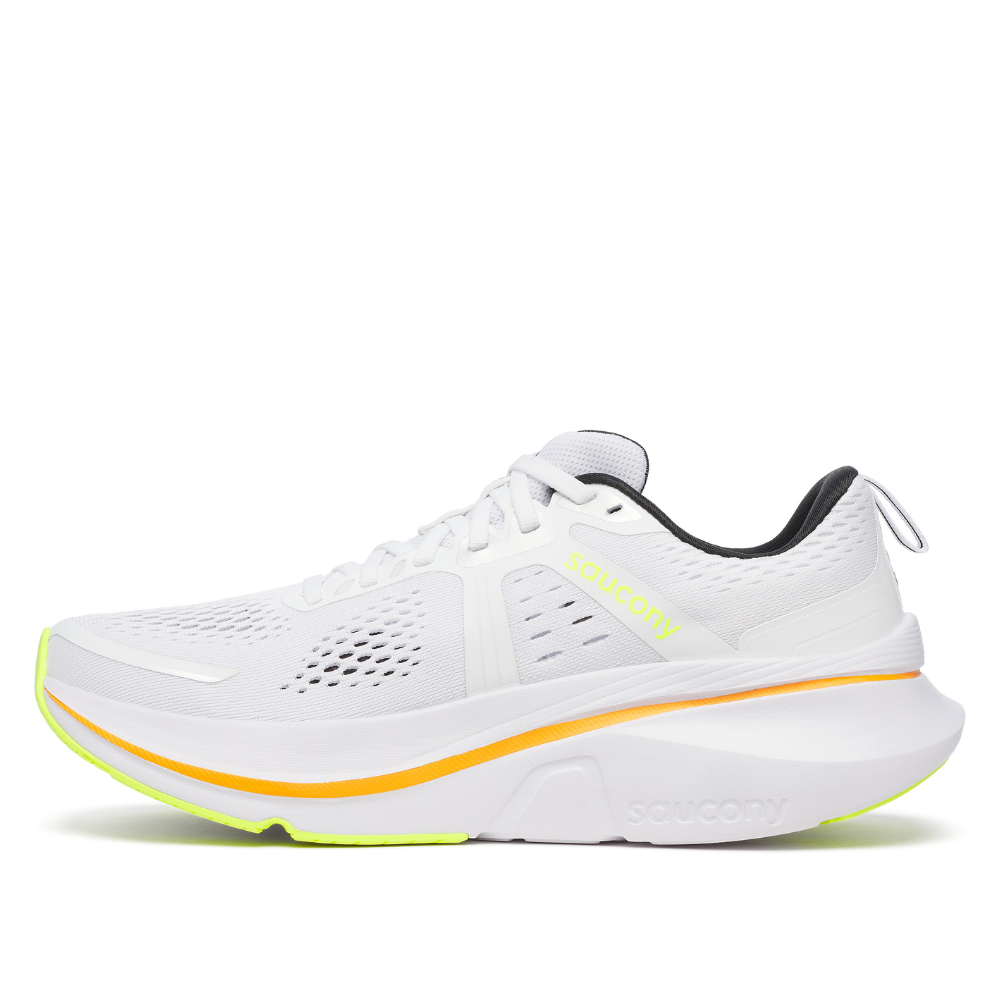
CenterPath geometry supplies subtle guidance without a traditional post.
Search Guide 18 on Amazon ↗
Dual-layer cushioning on a broad, supportive base.
Search Hurricane 25 on Amazon ↗Questions about this topic
Is Hurricane 25 an eight-millimeter-drop shoe?
Saucony’s official Hurricane 25 specification lists six millimeters. Check the exact generation rather than reusing an older model’s specification.
Does the Guide lack stability technology?
No. Guide 18 uses CenterPath geometry. The Hurricane comparison is about the whole cushioning and platform package, not support versus no support.